
For a versatile UV flashlight, I would choose filtered 365 nm, a rechargeable battery, and a medium-width beam. Here is how to match the features to your needs.
| Feature | What to look for | Why it matters |
|---|---|---|
| Wavelength | An explicit specification such as 365 nm, rather than simply “UV” | Different materials respond to different wavelengths. |
| Filter | A visible-light blocking filter matched to the wavelength; | Reduces purple light that can obscure faint fluorescence. |
| Batteries | Replaceable rechargeable cells, convenient charging, and a stated runtime | Determines operating cost, convenience, and how long you can search. |
| Beam | Flood, spot, or a balanced beam suited to your working distance | Controls how much ground you scan and how concentrated the UV is. |
Choose the wavelength first.
| Your main use | Recommended wavelength |
|---|---|
| Uranium glass | 365 or 395 nm; 395 nm is useful when comparing it with manganese glass |
| Manganese glass | 365 nm |
| Pet-stain inspection | Filtered 365 nm for better contrast |
| Scorpion hunting | 365 or 385–395 nm; beam strength and coverage also matter |
| General mineral exploration | Filtered 365 nm |
| Shortwave fluorescent minerals | 254 nm, using a dedicated mineral lamp |
365 nm generally produces less visible purple light than 395 nm (but is more expensive), allowing fluorescence to stand out more clearly. Shortwave mineral lamps are a separate category; a filter cannot change a flashlight’s wavelength.
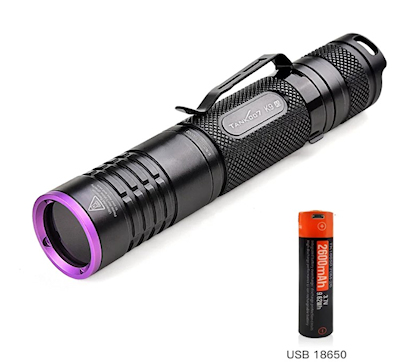 |
A filter improves contrast, not power. It blocks unwanted visible light while transmitting useful UV. A good filtered flashlight may look dimmer on an ordinary wall yet reveal fluorescence more clearly. Check that the filter is specified for the lamp’s wavelength. The dark lens is not an eye-protection feature.
For batteries, buy convenience and dependable runtime.
Check whether the battery and charger are included, whether the light requires a proprietary cell, and whether runtime applies to its highest setting. Use only the battery type and charger specified by the manufacturer.
Match the beam to the task.
| Beam | Best use | Trade-off |
|---|---|---|
| Wide flood | Carpets, nearby rocks, broad ground searches | Less concentrated intensity at distance |
| Narrow spot | Distant targets and inspecting small areas | Requires more sweeping to cover ground |
| Moderate spot with surrounding spill | General outdoor searching | A useful compromise |
Beam concentration affects range: a narrow beam can deliver stronger illumination to a distant patch without having greater total UV output. The Fluorescent Mineral Society
Do not judge UV performance by purple brightness, LED count, or lumens. Lumens measure visible light. Prefer a seller that states UV radiant output in milliwatts or watts, identifies the wavelength, and provides realistic beam and runtime information. Also distinguish UV output from electrical power consumption.
For your mix of glass, pet stains, and outdoor exploring, filtered 365 nm with a replaceable rechargeable battery and a balanced beam is my first choice. Add a small 395 nm light for glass comparisons, and a dedicated shortwave lamp if your mineral collection calls for it.
Avoid direct eye exposure with any UV light. 254 nm shortwave requires particularly careful shielding and suitable UV-rated eye protection, because it can injure eyes and skin.